
"The right to enter a temple is not dependent on a legislation. It is the constitutional right," the bench said.

The Kerala government has made it clear that it would not provide security to any woman of menstruating age visiting the shrine, as per Devaswom Board Minister K Surendran.
'This government has huge respect for the Supreme Court and when there is going to be a hearing on the review petition, it is appropriate to refrain from taking any action till then.'

As the situation went out of control, police first used water cannon and then burst tear gas shells to disperse the unruly crowd.

The issue of denial of permission to Mansiya V P to perform Bharatanatyam at Koodalmanikyam temple, Irinjalakuda in Thrissur district has become a matter of debate in the state.

Travancore Devaswom Board, which manages the shrine, said revenue collection on the opening day registered a growth of Rs 1.28 crore compared to last year.

Sasikala, said she was not allowed to undertake the trek to the shrine and sent back by the police, official sources said that she entered the sanctum sanctorum and offered prayers.

The Kerala government dubbed Desai's attempt to visit Sabarimala as a 'conspiracy'.

Opposition Congress termed the government's decision as 'unilateral' and said it was against the interest of a majority of Ayyappa devotees in and outside the state.

In a U-turn, the Left Democratic Front government of Kerala on Monday informed the Supreme Court that it favoured the entry of women of all age groups in the historic Sabarimala temple in the state.

Trupti Desai's fight earned women the right to enter the inner sanctums of the Shani Shingnapur Temple, the Trimbakeshwar Shiva Temple and the Haji Ali Dargah. Her next target is Sabarimala in Kerala. Aditi Phadnis reports.
Gandhi, however, acknowledged that his opinion is different from that of his party on the "emotional issue" after the Supreme Court last month lifted the ban on entry of women of menstrual age to the hilltop shrine of Lord Ayyappa in Kerala.
A nine-judge Constitution bench headed by Chief Justice S A Bobde at the outset said that it will only deal with the issues referred to it by a five-judge bench on November 14 in the Sabarimala case, and asked the lawyers to convene a meeting on January 17 to decide on 're-framing' or adding additional issues to be deliberated upon by it.

Meena said political parties should be responsible enough to decide to what extent they should use the Sabarimala issue during the campaign.
A five judge Constitution bench headed by Chief Justice Dipak Misra was apparently not in agreement with the argument of the Travancore Devaswom Board running the over 800-year-old Lord Ayyappa temple that the "practice and belief" that have continued uninterrupted cannot be tested on the ground of "modern ethos".

Chief Minister Pinarayi Vijayan made it clear that the Left government was with the believers.
'You can understand the ignorance and passion of people, but how can we forgive the authorities and police when they very well knew the dangers?' 'Just see how many families are destroyed.'

Temple priest performed a 'purification' ritual for an hour before the doors were opened again.
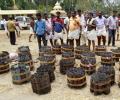
The police has registered a case against six persons, including members of temple managing committee and associates of firework contractors, on attempt to murder and other charges in connection with the Putttingal Devi temple fire tragedy, even as the toll rose to 109.
A majority verdict by Chief Justice Ranjan Gogoi and Justices A M Khanwilkar and Indu Malhotra decided to keep pending the pleas seeking a review of its decision regarding the entry of women into the shrine, and said restrictions on women in religious places was not restricted to Sabarimala alone and was prevalent in other religions as well.

Chief Minister Pinarayi Vijayan, however, told reporters that no one would be allowed to block devotees from proceeding to Sabarimala.

Police had earlier said it was verifying the background of the woman, said to be in her late 30s, and a decision regarding her trekking would be taken on Sunday morning.
The apex court said banning entry of women to Kerala's Sabrimala temple is gender discrimination and the practice violates rights of Hindu women.

'As a person who has seen the treasure, I am worried about its safety.'

The BJP/Rashtriya Swayamsevak Sangh and right wing outfits have made it clear that they would not allow any woman in the 10-50 age group to offer prayers at the shrine, where the deity is 'Naishtika Brahmachari' (perennial celibate).

'It is entirely possible that there are many treasures of our history and our faith buried deep underground,' points out Rajeev Srinivasan.
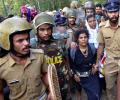
After several women were prevented from entering the Sabarimala shrine after the Supreme Court verdict upheld their right to do so, Bindu and Kanakadurga managed the seemingly impossible. Syed Firdaus Ashraf/Rediff.com finds out how they did it.
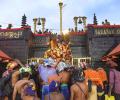
The Bharatiya Janata Party lined up several promises, including a legislation to protect traditions of the Ayyappa temple at Sabarimala and a law against "love jihad", while assuring employment for at least one person from each family and free laptops to high school students, in its manifesto for the assembly polls unveiled in Thiruvananthapuram on Wednesday.

The Supreme Court on Monday reserved its verdict on whether to refer the matters pertaining to the ban on entry of women aged between 10 to 50 years at Kerala's Sabrimala temple to its constitution bench.

Earlier, two women devotees could not proceed to the shrine after protesters forced them to return. Protesters pelted police with stones and the latter hit right back with vengeance wielding batons with telling effect, leaving many fallen and writhing in pain on the road.
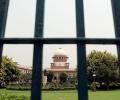
The Supreme Court is scheduled to pronounce on Thursday its verdicts on a batch of petitions seeking re-examination of its decision to allow entry of women of all age group in Kerala's Sabarimala Temple and a review of its judgment giving a clean chit to the Modi government in the Rafale fighter jet deal with French firm Dassault Aviation.

In a no-holds-barred interview, 20-year-old Nikita Azad discusses the backlash she has faced after #HappytoBleed, the campaign she launched to protest a derogatory statement made by the chief of the Sabarimala Devasom Board.

'The beef fest is about an individual's freedom to wear what he wants and eat what he wants. The students were protesting against the state interfering with their personal liberties.' 'Everybody has the right to air his or her opinion and lead a life they want. Nobody has any right to put restrictions on others. What we need is tolerance but what we see is intolerance.' Deepa Nisanth, a lecturer who backed Kerala's beef fest, on why she supported the students in their protest.

''This chief minister is so obstinate that he is ready to use the police to attain his goal.' 'Had he been more mature rather than obstinate, Kerala would not have reached a boiling point.'

'Our children score very high marks, but do not get admission in good colleges. They get top rank, but they do not get jobs because they belong to the so-called forward caste.' 'What can we do when a boy or girl from the community with first rank is considered only at the 6th or 7th position for a government job just because those with reservation get precedence over us?'

In a no-holds-barred interview, 20-year-old Nikita Azad discusses the backlash she has faced after #HappytoBleed, the campaign she launched to protest a derogatory statement made by the chief of the Sabarimala Devasom Board.
